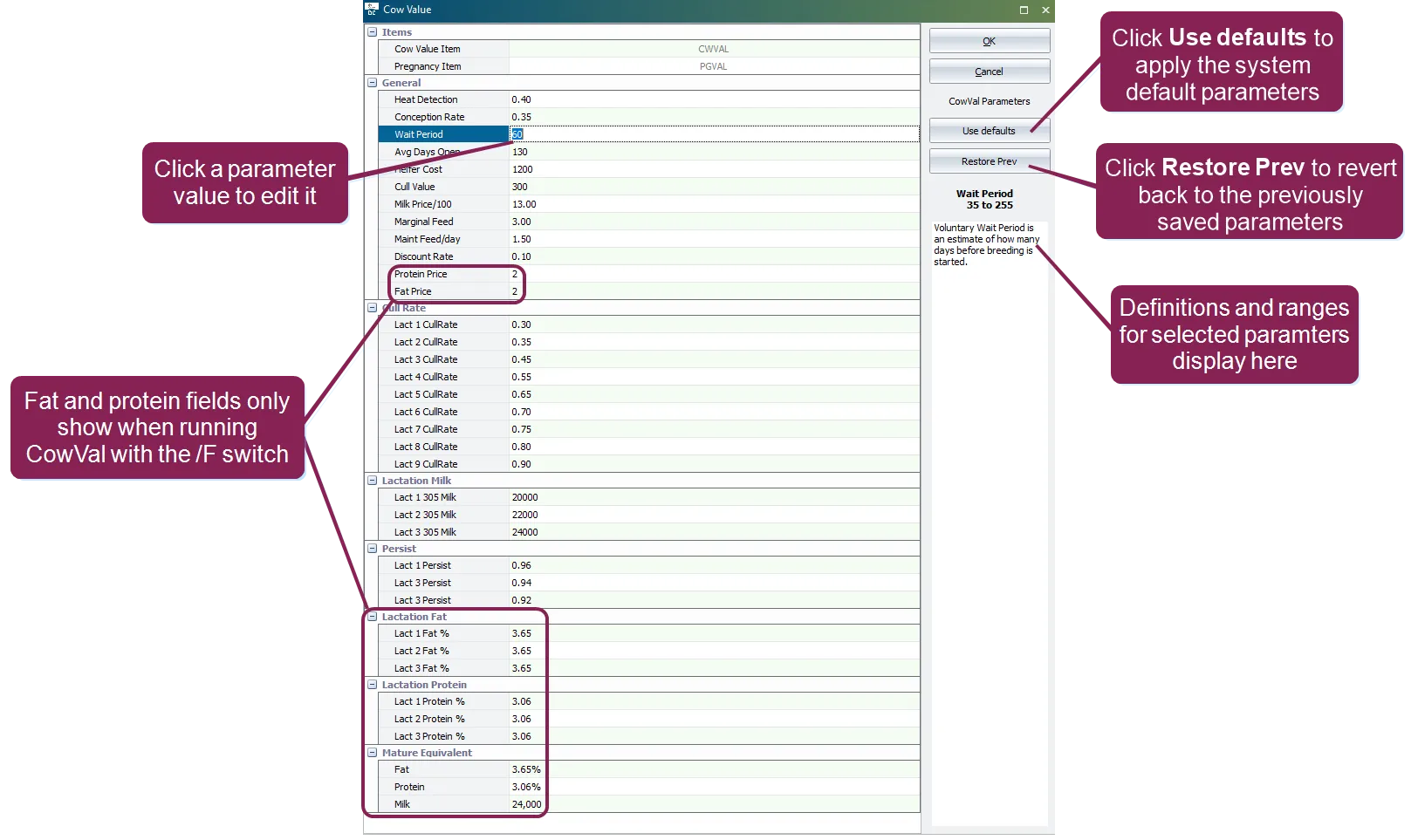
Set CowVal Parameters
2 min
cowval calculates the value of adult animals based on parameters for your herd think of parameters as the parts of an equation—when you change a parameter, the result of the equation changes too the parameters cowval uses need to be reasonably accurate in order to give you a useful estimate of an animal's value the first time you use cowval, it's helpful to have the system calculate the parameter values for you to do so, select calculate parameter estimates from the cowval menu this tool uses the animal data from your cowfile to estimate the pregnancy rate, heat detection rate, and the 305 day milk production averages after the system calculates the parameters, it presents them in the cow value window to accept these calculated parameters, click ok note the calculate parameters estimates tool may not work if you have a new herd, since there may be a lack of historical cowfile data to use see editing parameters docid\ lbdxqdml1zbhuhin1ahmi for more on adding parameters for a new herd cow value parameter definitions cow value parameters are defined as follows \<font color="#67854e">heat detection \</font> the ratio of heats observed to heats occurred most dairies have heat detection rates between 0 35 and 0 75 \<font color="#67854e">conception rate \</font> the ratio of conceptions to breedings most dairies have conception rates between 0 20 and 0 60 \<font color="#67854e">wait period \</font> the number of days in milk at which animals in heat will be bred \<font color="#67854e">average days open \</font> the average days in milk at conception \<font color="#67854e">heifer cost \</font> the cost to either raise or purchase a replacement heifer if a significant percentage of heifers die, consider adding that percentage to the purchase price \<font color="#67854e">cull value\</font> the average expected income from selling an animal the difference between heifer cost and cull value is the cash expense of replacing an animal \<font color="#67854e">milk price/100\</font> the expected milk price over the next few years per 100 pounds of milk \<font color="#67854e">marginal feed \</font> the estimated cost of the incremental feed required to get this additional milk a quick estimate is the cost of 40 units (pounds) of dry matter \<font color="#67854e">maint feed/day \</font> the daily feed expense to feed a cow not including milk production a quick estimate is the daily cost to feed a dry cow or a springing heifer \<font color="#67854e">discount rate \</font> the expected annual return a dairy should get on money invested today it is usually slightly higher than the current interest rate \<font color="#67854e">protein price \</font> the expected price of protein over the next few years, per unit (1 pound/kg) of milk this parameter is only included when running cowval with the \f switch \<font color="#67854e">fat price \</font> the expected price of fat over the new few years, per unit (1 pound/kg) of milk this parameter only appears when running cowval with the \f switch \<font color="#67854e">cull rate \</font> the percentage of animals that do not reach the next lactation most dairies cull between 0 20 to 0 55 per lactation this number tends to increase with age dairies with excellent reproduction and low calf losses can approach 50 unless they market springing heifers \<font color="#67854e">lactation 305 milk \</font> the predicted average 305 day milk production for each lactation \<font color="#67854e">persist \</font> the estimated monthly change in milk production once an animal is past her peak production \<font color="#67854e">lactation fat\</font> the estimated 305 day fat production as a percentage of milk for each lactation this parameter is only included when running cowval with the \f switch \<font color="#67854e">lactation protein \</font> the estimated 305 day protein production as a percentage of milk for each lactation this parameter is only included when running cowval with the \f switch \<font color="#67854e">mature equivalent \</font> these fat, protein, and milk percentages are based on data from the mature animals in your herd and are used by the cowval formula to better compare animals in a mixed breed herd editing parameters calculated parameters can be edited and adjusted by selecting edit parameters from the cowval menu this option can also be used when setting up parameters for a new herd that does not have cowfile data from which parameters can be calculated use the following guidelines when setting cowval parameters when you click on a parameter, a definition for it appears on the right side of the window, along with a range of values for that parameter to edit a parameter, click on its value and then enter a new one to use the system default values for each parameter, click use defaults to revert to a previously saved version of parameter values, click restore prev once you've set your parameters, click ok once you have set up your parameters, you're ready to start estimating animal values! see estimate cow value docid\ hixmopbwg2vfaqjg49cw2 for more information