Estimate Cow Value
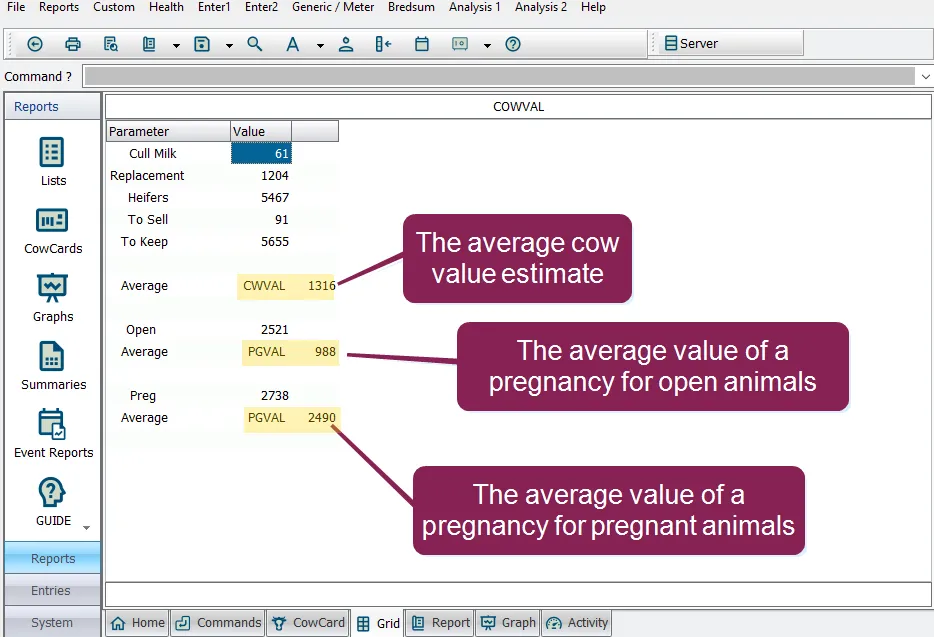
To calculate your CowVal estimate, select Estimate Cow Value from the CowVal menuCowVal menu. Once the calculation completes, the system displays a summary window containing its estimates.
IMPORTANT: The first time you use the Estimate Cow Value option, the system prompts you to create the two new DairyComp items it uses to display animal values—CWVAL (to store the Cow Value estimate) and PGVAL (to store the value of a pregnancy). Agree to these changes when prompted.
In CowVal, an animal's current value is the sum of her value for beef and the value of the milk she's likely to produce in the future. This future production is based on:
- The amount of milk she is likely to produce in the future.
- The price of milk in the future.
- The value of the money you need to invest in the animal.
- Age: The younger the animal, the longer she is likely to stay in the herd and produce milk.
- Stage of lactation: An animal that is 30 days in milk is likely to produce more milk in the future than an animal that is 200 days in milk.
- Reproductive status: An animal that is pregnant is likely to produce more future milk than an open animal. And an animal that's just been inseminated is more likely to be pregnant than an animal that hasn't been inseminated.
- Production level: A high producing animal is likely to produce more milk than a low producing animal.
The following data is included in the summary window:
- Cull Milk: The amount of milk in pounds that animals marked as "do not breed" must make in order to pay for themselves.
- Replacement: The cost required to replace a culled animal.
- Heifers: The total number of heifers (LACT=0). Heifers are not assigned a Cow Value.
- To Sell: The number of animals that have a negative Cow Value. Based on CowVal estimates, these animals should be replaced with an average heifer.
- To Keep: The number of animals with a positive Cow Value. These animals are more valuable to keep than to replace with an average heifer.
- Average CWVAL: The average Cow Value assigned to the animals in the herd.
- Open: The total number of open animals (i.e., animals confirmed not to be pregnant).
- Average PGVAL: The average value by which an open animal would increase if she became pregnant.
- Preg: The number of confirmed pregnant and dry animals.
- Average PGVAL: The average value added to the currently pregnant animals. Note that this is also the average value amount that a pregnant animal would decrease if their pregnancy was lost. This number will vary for individual animals based partially on the current length of their pregnancy; the farther along they are in the pregnancy, the more that pregnancy is worth.
Once you have calculated your Cow Value estimates, you can view them in the reports you run in DairyComp.
NOTE: Before running a DairyComp report, you'll need to exit out of CowVal. To do so, select Exit from the CowVal menu. You can always return to CowVal by entering COWVAL in the command line.
There are many ways of using the CWVAL and PGVAL items in reports. A simple way to start is to list all adult animals sorted by CWVAL. To do so, enter SHOW ID CWVAL PGVAL FOR LACT>0 BY CWVAL in the command line. The results of your report will look like this.
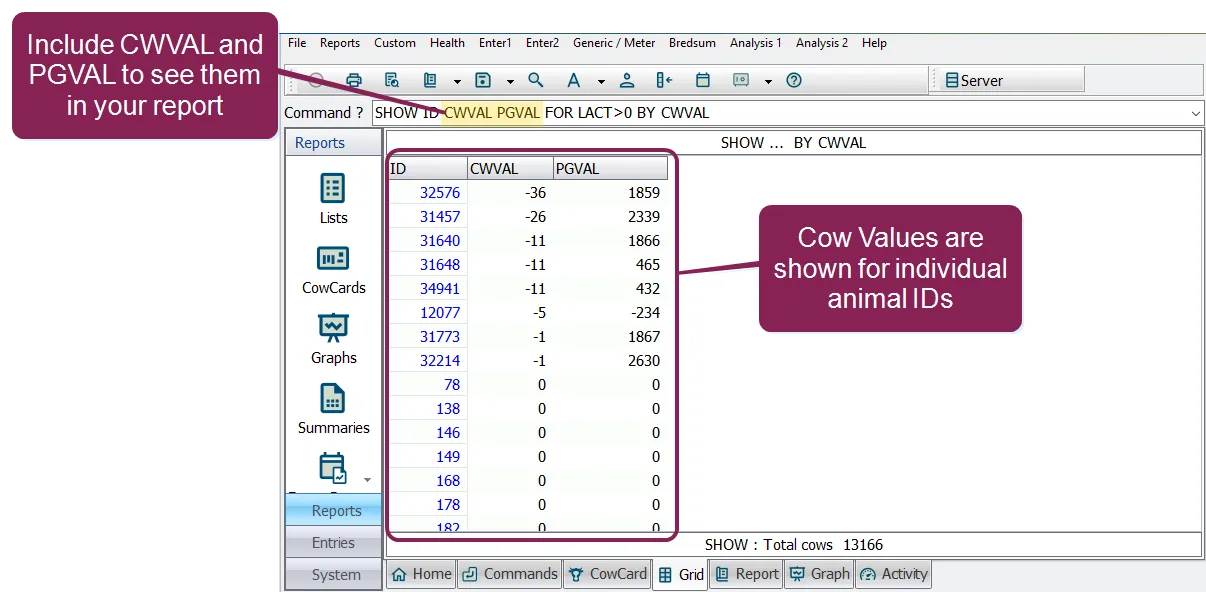
Notice that the animals with the lowest value are at the top of the list. The animals with the highest value are at the bottom of the list.
Of course, you'll want to include a lot more information in your reports in order to get the most useful cow value data. For example, if you include reproduction status, you'll be better able to interpret the PGVAL value.
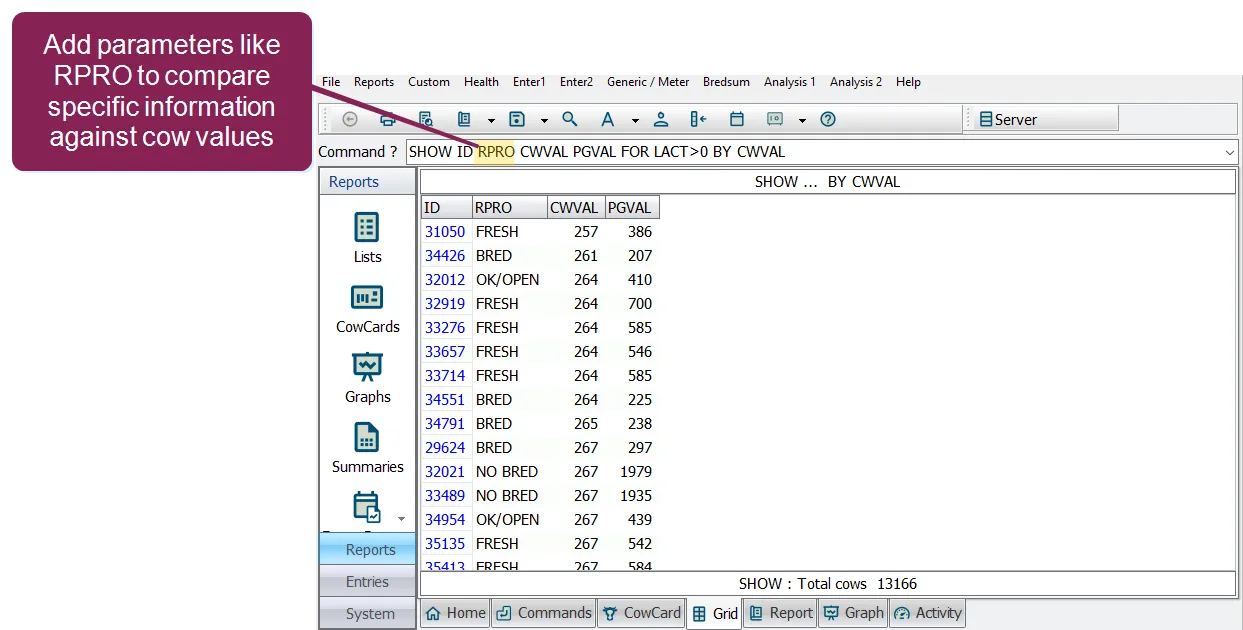
See Command LineCommand Line to learn more about command line functionality and syntax.
Use the following guidelines when interpreting cow values and reproductive status:
- If an animal is not pregnant, then the value of getting her pregnant would be her current PGVAL. So, if she became pregnant today, her new CWVAL would be her current CWVAL plus her current PGVAL.
- If an animal is pregnant, her CWVAL already includes her PGVAL. But if she were to abort the pregnancy, then her CWVAL would decrease by the PGVAL.
- If an open animal is bred, her CWVAL goes up because she is more likely to be pregnant than before she was bred, so she is more likely to produce milk into the future.
You can use many different items to build your CowVal reports, such as LACT (lactation number), DIM (days in milk), and MILK (for last testday milk weight). You can also use FOR statements in your report to narrow down your list. In the example below, the FOR DIM>75 only includes animals with more reliable production estimates. It also includes numerous other items (LACT, DCC, etc.):
SHOW ID LACT DIM MILK RV RPRO DSLH DCC CWVAL PGVAL BY CWVAL FOR DIM>75
Let's look at an example using the command above and interpret the results:
ID | LACT | DIM | MILK | RV | RPRO | DSLH | DCC | CWVAL | PGVAL |
|---|---|---|---|---|---|---|---|---|---|
42 | 3 | 84 | 26 | 59 | BRED | 11 | 0 | -757 | -248 |
14 | 3 | 85 | 45 | 70 | BRED | 53 | 0 | -646 | 157 |
68 | 1 | 125 | 48 | 72 | BRED | 27 | 0 | -410 | 587 |
32 | 3 | 457 | 47 | 11 | DNB | 0 | 0 | -330 | 449 |
99 | 3 | 209 | 14 | 85 | BRED | 16 | 0 | -330 | -325 |
These values are from the top of the list. Remember that the animals of lesser value are at the top.
Animal 42 is the least valuable animal in the herd. Her CWVAL is -$757 relative to an average heifer in the herd. If she were to get pregnant her value would decrease another $248 because she might be kept for another lactation rather than replacing her with a more profitable animal. This suggests that the dairy will make more money, beginning today, if she's replaced with an average, fresh, first-lactation animal.
Animal 68 has a negative CWVAL, but her PGVAL tells us that if she turns out to be pregnant from this current breeding (27 days ago) her value will become +$587 + (-$410) = +$147. That means she will become $147 more valuable than an average fresh heifer in this herd.
Animal 32 has been marked as do not breed (DNB). Her CWVAL shows that she should be replaced, while the PGVAL tells us that she would have been $449 more valuable had she gotten pregnant earlier in this lactation.
Now let's jump to the end of the report. This is where the most valuable animals are listed:
ID | LACT | DIM | MILK | RV | RPRO | DSLH | DCC | CWVAL | PGVAL |
|---|---|---|---|---|---|---|---|---|---|
54 | 1 | 484 | 0 | 12 | DRY | 335 | 274 | 1782 | 2789 |
25 | 1 | 465 | 79 | 30 | PREG | 127 | 131 | 1791 | 1359 |
26 | 1 | 332 | 0 | 36 | DRY | 246 | 246 | 1814 | 2821 |
53 | 1 | 343 | 82 | 13 | PREG | 123 | 91 | 1912 | 1426 |
Animal 53 is the most valuable animal in the herd. She's pregnant, but notice that if she aborts her value will drop from $1912 to $486 ($1912-$1426). Animal 26 is also pregnant, and if she aborts her value will drop from $1814 to –$1007, meaning that she should be sold.
One of the best times to decide to stop breeding an animal is when the veterinarian declares her open at a pregnancy exam. Having the Cow Value estimates on the vet list can make that decision easier and more consistent.